My Reading Summary: 2025
With a side order of geekiness

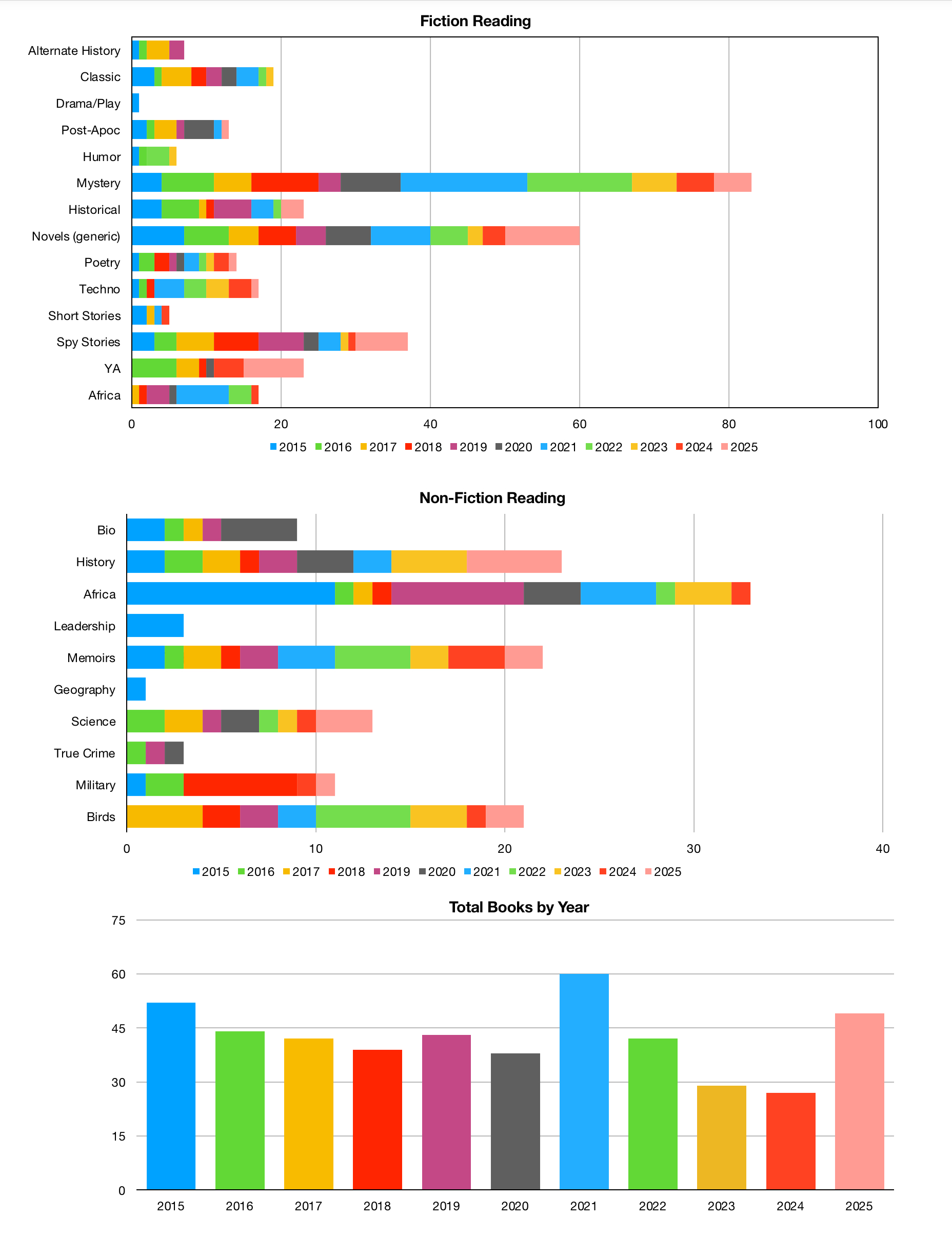
Four words: better than last year. At the end of 2024, I resolved to try to do two things: replace doom scrolling with more reading and be more intentional about what I read (i.e., fall victim less often to ‘the thing that caught my eye most recently’). How did I do? Better on the former than the latter.
By volume of books read, 49, this was my biggest year since 2021, and my third biggest since I started keeping track in 2015.
By quality, it wasn’t bad either. This is much more qualitative, but I was generally pleased. Going back over my list, there were really only two that were a slog to finish — I was just waiting for them to end. One fiction, one non-fiction. Even with that, they both had their redeeming qualities.
My top ten reads of the year (in the order I read them):
1. Bear Town, Fredrik Backman
2. The Doorman, Chris Pavone
3. The Ministry of Time, Kaliane Bradley
4. Cod: A biography of the Fish that Changed the World, Mark Kurlansky
5. On Tyranny, Timothy Snyder
6. The Predicament, William Boyd
7. Children of the Savage City*, Elizabeth Heider
8. Yesteryear*, Caro Claire Burke
9. What We Can Know, Ian McEwan
10. A Keeper, Graham Norton
*: Because I have the good fortune to be married to someone in the industry, we get Advance Reader Copies of some books. These two will publish in 2026. Both were awesome. I’m proud to know the author of the first, but it would be on this list if I didn’t. The second will be a “much talked about” book when it releases – it already is. Some will hate it.
My book resolutions for 2026? I’m going to keep it to two, and one is a repeat.
1. Be more intentional. I don’t have a measurement or this. Assessment, monitoring and evaluation experts will be displeased.
2. For books read in 2026, my fiction-to-non-fiction ratio will be at my 11-year average of 2.34 or lower. To make the pedants happy: Specific? Yes, I think so. Measurable? Yes, I track every book I read. Achievable? Yes, this year’s ratio was 2.77 but as recently as 2023 it was 1.15 and the overall average is skewed by 2021 (4.45) when the pandemic pushed me into a lot more fiction. Relevant? Is any of this really relevant? Time-bound? Yes.
Below is a bit of geekiness. (Bonus, here is the link to my Goodreads “2025 Year in Books”.)